
The short answer
A gas spring is defined by its extended length, its stroke and its force, given in newtons. A replacement must match all three and the end fittings; otherwise the tailgate or bonnet will not lift, hold or close the way it did.
How a gas spring works
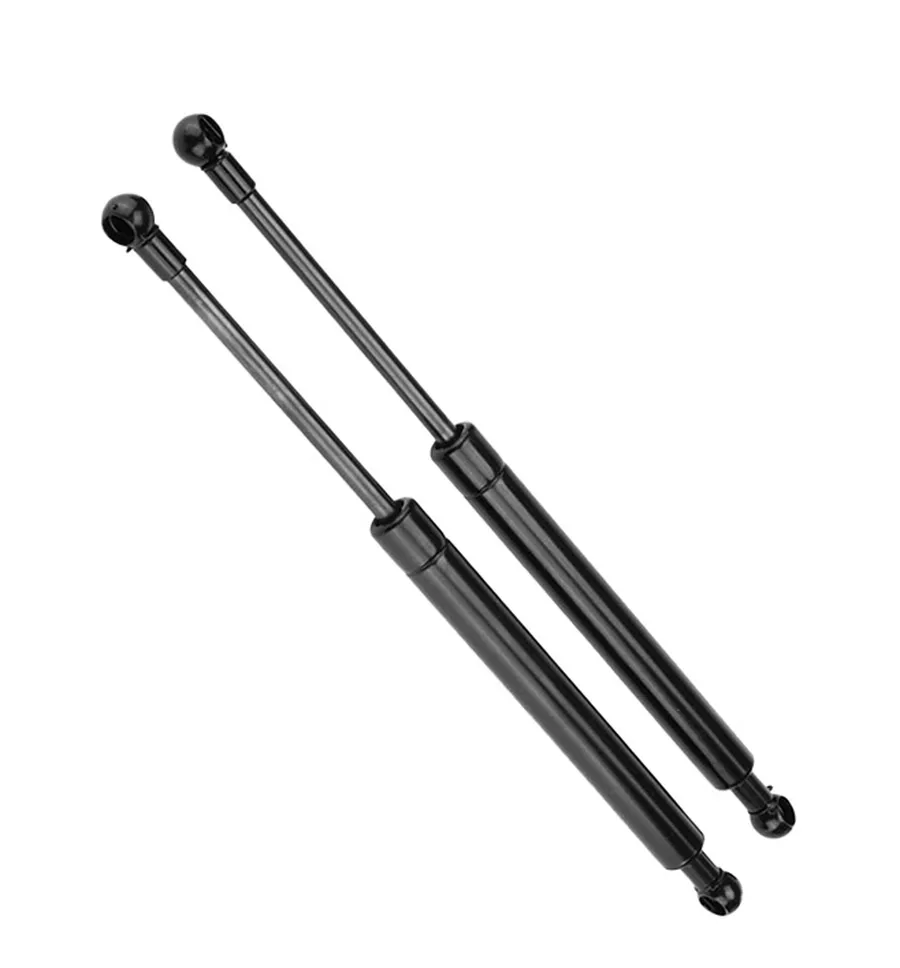
A gas spring stores energy in compressed gas instead of in a coiled metal spring. A sealed cylinder holds a charge of high-pressure nitrogen, a small amount of oil and a piston on a rod with a sliding seal. Channels in the piston let the gas move from one side to the other, so the pressure is the same on both sides wherever the piston is. The rod is pushed outwards because it occupies space inside the cylinder: as the rod is pushed in, the volume left for the gas shrinks and the gas pushes back harder.
On a car, gas springs hold up tailgates, boot lids and bonnets.
The three numbers
| Value | What it means |
|---|---|
| Extended length | The overall length of the spring with the rod fully out, measured between the centres of the end fittings |
| Stroke | How far the rod travels between fully extended and fully compressed |
| Force (F1) | The static push of the rod near full extension, in newtons |
The force is measured with a dynamometer at about 20 °C with the rod pushed in by about 10 mm from full extension, so the reading is free of the friction of the seal. This static value, F1, is the force quoted for the spring. Because the gas is compressed further as the rod goes in, the force at full compression, called F3, is higher than F1; the difference is the spring’s progression.
Why the lid feels different in winter
The force of a gas spring changes by about 0.36 % per degree Celsius, roughly 3.6 % for every 10 °C, because the nitrogen expands or contracts at constant volume. A tailgate that is easy to hold up in summer can drift down in cold weather even with springs in good condition. A spring is designed for an operating range of about -30 °C to +80 °C.
Fitting position and service life
A gas spring is installed with the rod pointing downwards, or at least with the rod guide in the lower position, so that the oil inside keeps the seal lubricated. The life of the spring depends on that lubrication; a spring fitted rod-up wears its seal faster and loses gas sooner.
Springs lose force gradually as gas escapes past the seal. A lid that no longer stays open, needs a hand to stay up, or closes on its own is the usual sign.
Choosing the replacement
Read the extended length, the stroke and the force from the original part or from the catalogue entry for the vehicle, and check the end fittings match the vehicle’s ball studs. Where a tailgate uses two springs, fit both at the same time so the two sides push evenly. Trade customers can request the matching ZEIK reference and OE cross-references by email.