
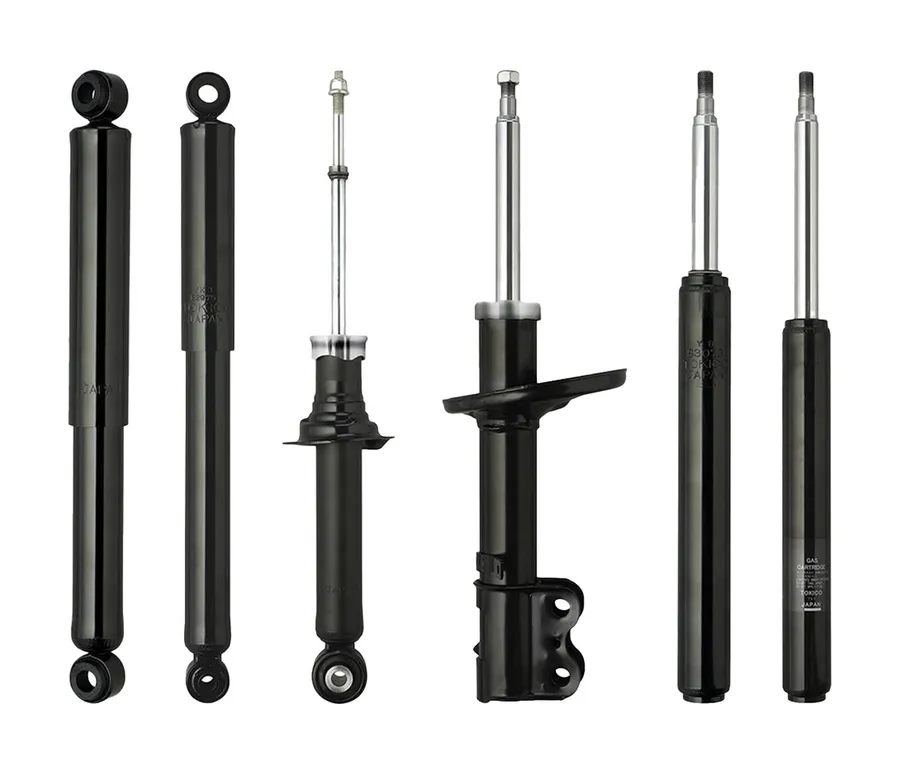
The short answer
Neither design is universally better. For a normal passenger car a good gas-charged twin-tube is the sensible choice; a monotube only pays off when its extra performance is actually used, such as hard driving, heavy loads or rough roads. Quality and the correct valving for the car matter more than the tube type.
How the two designs are built
A twin-tube shock absorber has two nested cylindrical tubes: the inner working tube in which the piston moves, and an outer reserve tube. Hydraulic fluid moves between chambers through small orifices in the piston, and the reserve tube takes up the fluid displaced by the rod. In the gas-charged version a low-pressure charge of nitrogen is added to the reserve tube, which produces a marked reduction in foaming, also called aeration, of the fluid.
A monotube shock absorber has a single tube. A floating piston separates the fluid from a chamber of nitrogen under high pressure. Because there is no outer tube, the fluid is in direct contact with the outside wall, and because the gas pressure is high the unit can even carry a small part of the vehicle’s weight.
| Characteristic | Twin-tube (gas-charged) | Monotube |
|---|---|---|
| Construction | Two nested tubes, low-pressure nitrogen in the reserve tube | One tube, floating piston, high-pressure nitrogen |
| Heat | Fluid works inside the inner tube; more fade under sustained hard use | Dissipates heat better, so damping stays consistent when worked hard |
| Ride | Comfortable; the design tolerates a rougher road surface | Firmer, more precise response |
| Mounting | Must be mounted mostly upright | No directionality, can be mounted either way |
| Damage | Tolerates dents in the outer tube and stone hits | A dent in the single tube can seize the piston |
| Length | Compact; what most passenger cars are designed around | Consistently longer overall, which can make it hard to fit where a twin-tube was specified |
| Cost | Lower | Higher |
Which are the best shock absorbers for your car
The best shock absorbers are the ones that match how the car is used, not the most expensive ones.
Choose a monotube if the car is driven hard, tows or carries heavy loads, sees track days or very rough roads, or if a sharper response is wanted. It resists fade, cools better and responds more precisely.
Choose a twin-tube if the car is a daily driver, comfort and cost matter, or the road surface is rough enough that a firm ride would be tiring. It is also more forgiving of stone hits and small dents.
What ZEIK builds
ZEIK shock absorbers, struts and shock absorbers with spring seat are gas-charged twin-tube units. The nitrogen charge reduces the aeration and foaming that degrade damping; the all-weather fluid carries friction-reducing modifiers so the rod reacts smoothly from cold; the piston rod is hardened and chrome-plated; and the end eye ring is seamless so the gas charge is retained without excessive wear. On struts the piston is multi-layer electroplated, cracked and hardened chrome, and the spring seat and mounting bracket are integrated into the body so the damping force acts on the vertical path of the coil spring.
Choosing a replacement
Match the replacement to the vehicle, the axle and the fitting position (left or right), and confirm the OE reference number of the part being removed. Twin-tube and monotube units for the same vehicle are usually not interchangeable in length or mounting. Trade customers can request the matching ZEIK reference and OE cross-references by email.